Lost rent after a fire: how fair rental value coverage pays a small landlord, month by month
When a rental property burns, landlords think first about the building. The building is usually the easier problem. The mortgage, property tax, and insurance bills keep arriving while the rent stops, and a rebuild that runs into permit delays can stretch a cash-flow gap past a year.
The coverage that fills that gap goes by several names: fair rental value, loss of rents, or rental income coverage. On a dwelling policy for a one-to-four-unit rental it's usually Coverage D. This guide walks through a full worked example on a duplex: how the payment is calculated, what gets deducted, where the time limit bites, and how the landlord's policy and the tenants' policies divide the costs.

What fair rental value coverage pays
Fair rental value coverage pays the rent you would have collected while the property, or part of it, can't be lived in because of a covered loss. Three details in the wording decide the amount:
- Rent minus non-continuing expenses. The policy pays lost rent minus expenses that stop while the unit is empty. If you normally pay a unit's water and trash and those charges stop, they come off the payment.
- The time it should reasonably take to repair. Payment runs for the period it reasonably should take to restore the unit, not necessarily the period it actually takes. Delays you cause, or don't push back on, can fall outside it.
- A limit. This may be a dollar limit, often 10% or 20% of the dwelling limit, a time limit such as 12 months, or both.
The coverage also usually applies when a civil authority bars access to the property because of damage to a neighboring property, typically for a short period such as two weeks.
A worked example: fire in one side of a duplex
A landlord owns a duplex. Each unit rents for $1,850 a month, and the landlord pays each unit's water, sewer, and trash, which comes to about $90 a month per occupied unit. The property's carrying costs are $2,750 a month: mortgage, property tax, and insurance.
A kitchen fire guts unit A. Smoke and a utility shutoff make unit B uninhabitable for two months. Unit A's rebuild runs 15 months, because the permit review and a structural redesign take longer than expected. The dwelling policy's fair rental value coverage has a 12-month time limit.
| Item | Calculation | Amount |
|---|---|---|
| Unit B lost rent, months 1–2 | 2 × ($1,850 − $90) | $3,520 |
| Unit A lost rent, months 1–12 | 12 × ($1,850 − $90) | $21,120 |
| Total paid by the policy | $24,640 | |
| Unit A lost rent, months 13–15 | 3 × $1,850, past the 12-month limit | $5,550 not covered |
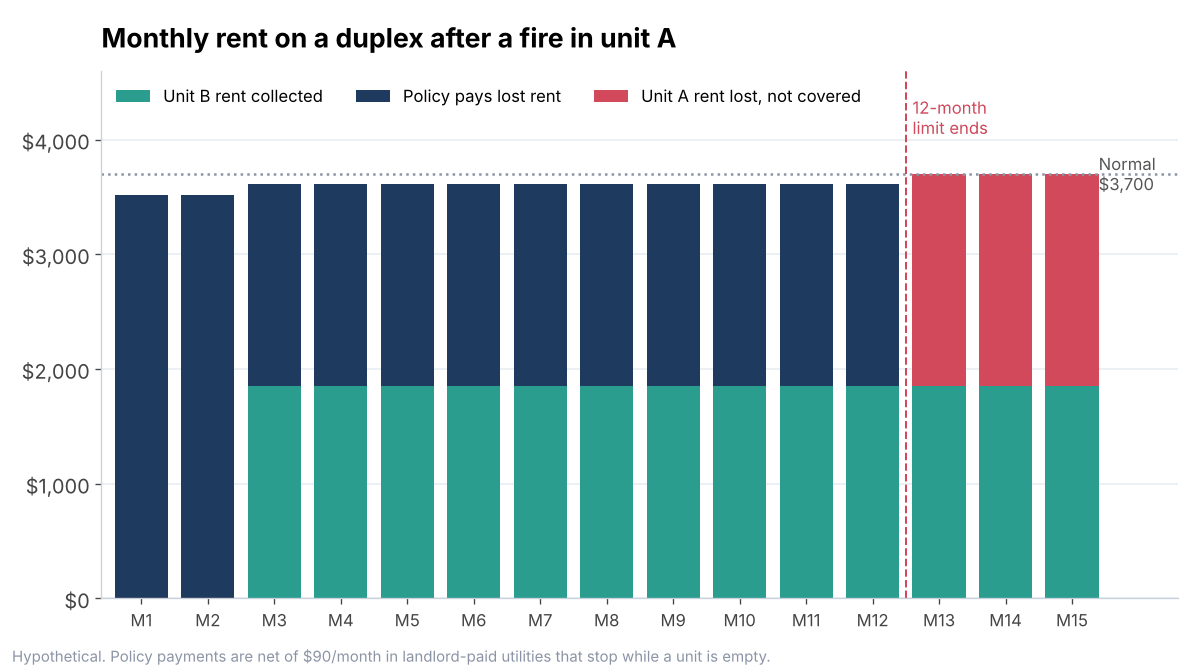
The payment is close to full rent, minus the small non-continuing expenses, for as long as the coverage lasts. The exposure is the tail: the months after the limit.
What it does to cash flow
Before the fire, the duplex brought in $3,700 a month against $2,750 in carrying costs and $180 in utilities, a margin of $770. Here is how the landlord's cumulative cash position looks over the 15 months in three cases:
| Case | Cumulative cash after 15 months |
|---|---|
| No fire | +$11,550 |
| Fire, with fair rental value coverage | +$6,270 |
| Fire, without rent coverage | −$18,370 |
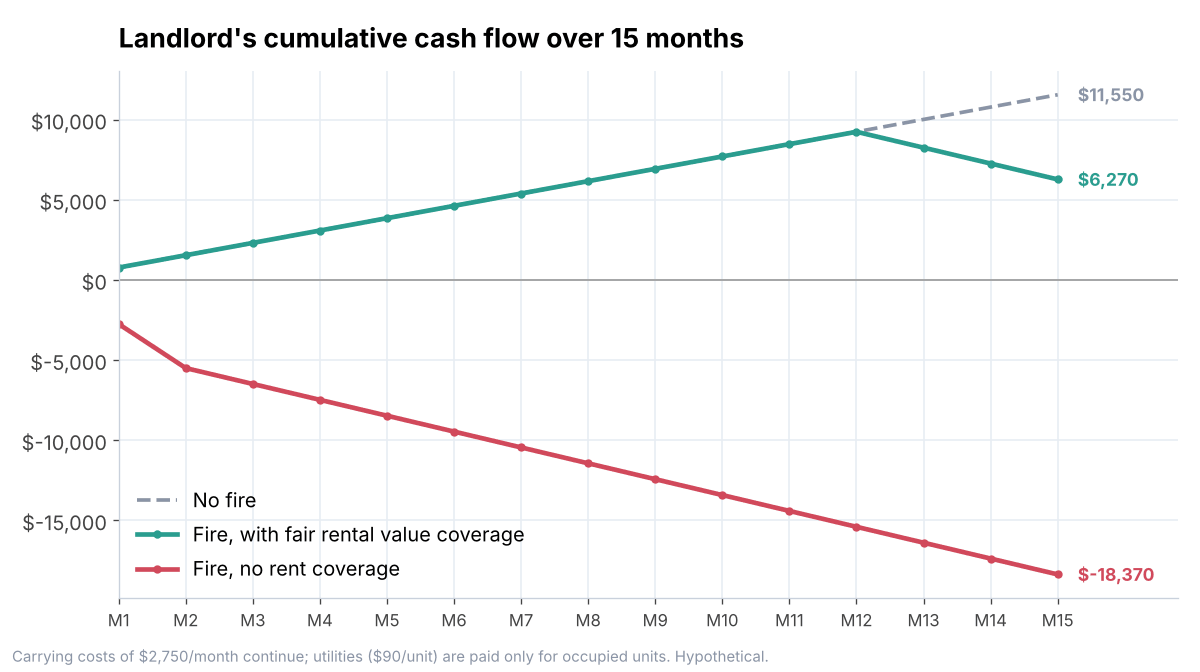
The gap between the two fire lines, $24,640, is exactly the policy payment. Even with coverage, the landlord ends up $5,280 behind the no-fire case. That's the $5,550 of rent lost after the 12-month limit, less $270 of unit A utilities the landlord didn't have to pay during those months. A long rebuild costs real money even with good coverage. The coverage just keeps that cost manageable.
Who pays what: landlord's policy vs. tenants' policies
The landlord's dwelling policy covers the landlord's building and the landlord's lost rent. It does not cover the tenants' belongings or their hotel bills. Those fall to each tenant's renters policy, if they have one.
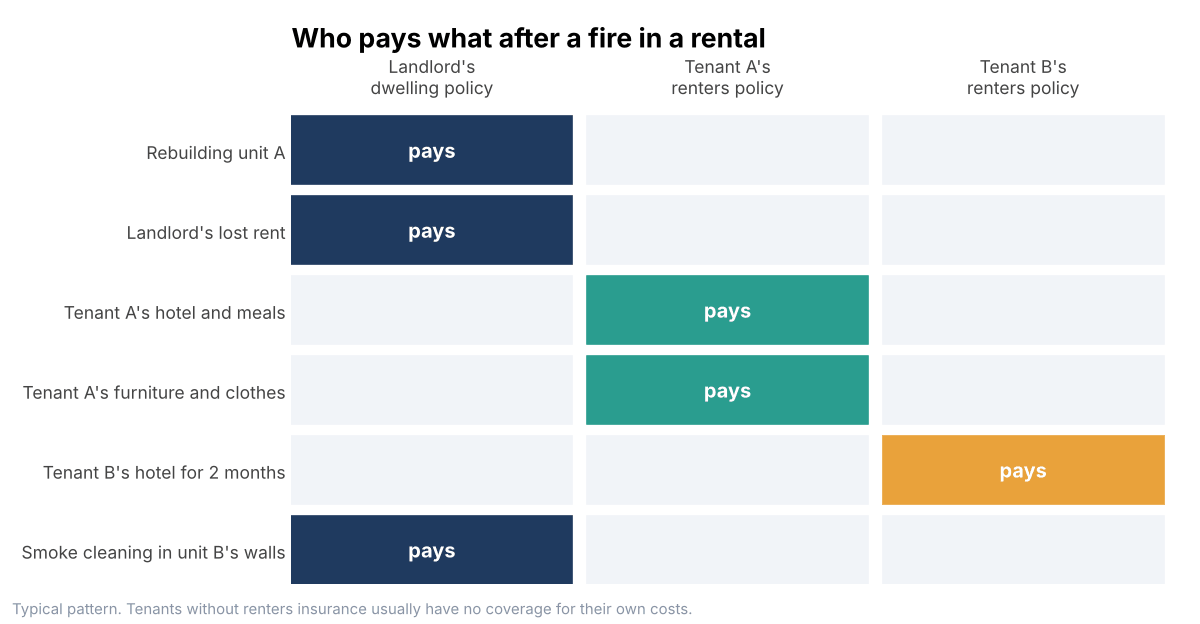
This is why many landlords require renters insurance in the lease. A tenant who has nowhere to go and no coverage often puts pressure on the landlord, and occasionally makes a liability claim, arguing that the landlord caused the fire.
Where the gaps are
Time limits. Twelve months sounds generous until permit queues, contractor shortages, or a code-required redesign come into play. If your area has long permit times, ask whether a longer period or a higher dollar limit is available.
Code upgrades. Rebuilding to current code can add both cost and time. Building costs fall under ordinance or law coverage. The extra time may or may not be covered by fair rental value, depending on wording.
Vacant units. If a unit was empty and not under a lease at the time of the loss, there's usually no rent to lose. Some policies pay fair rental value for a unit held for rental. Many pay nothing for a unit that wasn't rented. If the property was vacant for an extended period before the loss, separate vacancy restrictions may reduce coverage for the claim itself.
Short-term rentals. Nightly rental income is often excluded from standard dwelling and homeowners policies or limited by a home-sharing endorsement. A landlord running a unit on a booking platform needs coverage written for that use.
Homeowners vs. landlord policies. If you rent out a property but still insure it under a homeowners policy, there may be no rental income coverage at all, and the claim itself may be at risk. For a side-by-side look at what changes when a home becomes a rental, see this comparison of landlord insurance vs. homeowners insurance.

How to document a lost-rent claim
The insurer will want proof of the rent you were actually earning and the expenses that stopped. Have these ready:
- Current leases for every unit, including rent amounts and end dates.
- A rent ledger or bank deposits showing rent actually received over the past 6 to 12 months.
- Utility bills showing which expenses you pay and which stopped during the vacancy.
- A repair timeline from your contractor, updated in writing whenever it slips, with the reason.
- Permit records showing application and approval dates if delays are permit-related.
- Notices to tenants, including any lease terminations and the dates units became uninhabitable.
Submit lost-rent claims monthly rather than in one lump at the end. Monthly claims keep cash coming in and make each payment easier to verify.
A landlord's checklist for the policy itself
- Does the policy include fair rental value or loss of rents coverage, and is it a dollar limit, a time limit, or both?
- Is the limit enough for a realistic worst-case rebuild in your area, including permits?
- Does the policy include ordinance or law coverage, and does the rent coverage extend for code-related delays?
- Does the lease require tenants to carry renters insurance with liability coverage?
- If any unit is used for short-term stays, does the policy say so in writing?
- Are you on a landlord or dwelling form rather than a homeowners form?
Frequently asked questions
Does fair rental value pay if my tenant stops paying because of the damage? Coverage applies when the unit can't be lived in because of a covered loss. Unpaid rent from a tenant who still lives there is a collection or lease issue, not an insurance claim.
Is the payment taxable? Rent replacement payments are generally treated as rental income. Ask a tax professional how to report them.
Can I collect lost rent if I decide not to rebuild? Usually only for the time it would reasonably take to repair. If you sell or don't rebuild, payments typically stop or are limited.
Does a renters policy cover the landlord's lost rent? No. A tenant's renters policy covers the tenant's own belongings, liability, and loss of use, not the landlord's income.
Sources and further reading
- Insurance Information Institute: Insurance for landlords and renters
- National Association of Insurance Commissioners: Consumer insurance resources
- U.S. Department of Housing and Urban Development: Information for landlords
Hypothetical figures. General information only, not insurance, tax, or legal advice. Coverage terms vary by insurer and state; your policy wording controls.