The 60-day vacancy clause: what an empty rental loses in coverage, and how to keep it
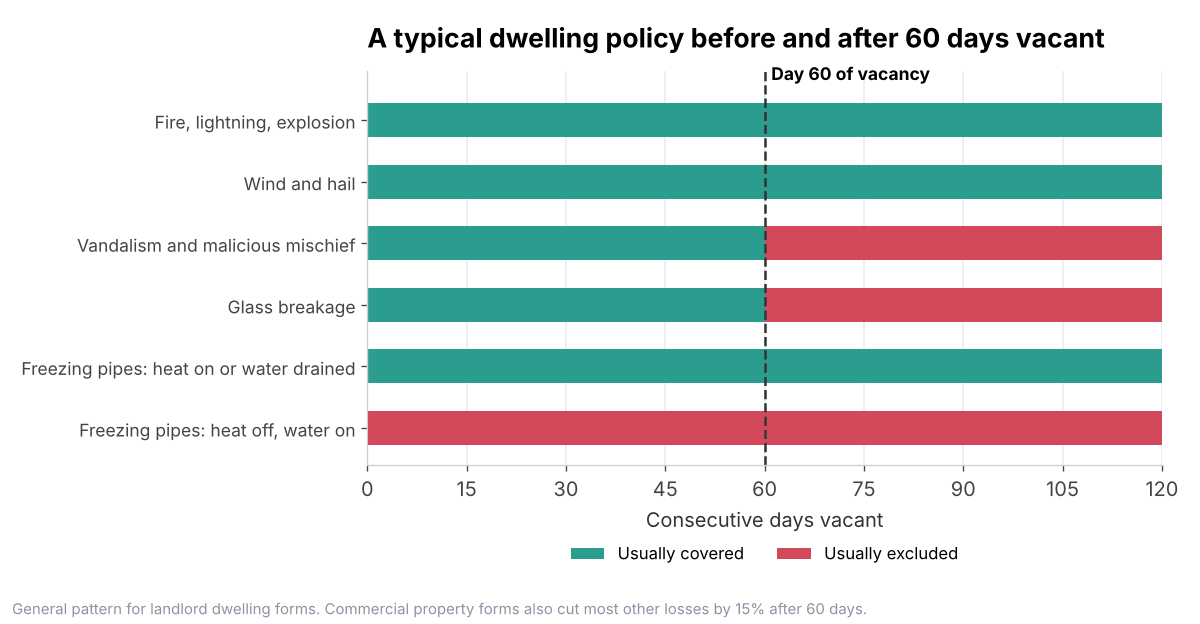
Most rental property policies contain a short clause that does nothing as long as tenants keep turning over quickly. Leave the property empty for more than 60 days in a row, and that clause quietly removes some of the coverage that matters most for an empty building: vandalism, glass breakage, and often water damage. A commercial policy may also cut every other claim by 15%.
Landlords run into it during the times they're least likely to be watching: a long renovation between tenants, an estate property waiting to sell, a slow rental market. This guide explains what the clause does, how vacant differs from unoccupied, what happens to real claims after day 60, and the simple steps that keep coverage intact.
What the vacancy clause says
The exact wording varies, but the pattern is consistent across landlord dwelling policies and commercial property policies:
| Policy type | After 60 consecutive days vacant |
|---|---|
| Landlord dwelling policy | Vandalism and malicious mischief excluded; glass breakage often excluded; freezing damage excluded unless heat is kept on or the water is shut off and the system drained |
| Commercial property policy | Vandalism, sprinkler leakage, building glass breakage, water damage, theft, and attempted theft excluded; every other covered loss reduced by 15% |
| Homeowners policy (owner moved out) | Vandalism excluded after 60 days vacant; the bigger problem is that a homeowners policy may not cover a home you no longer live in at all |
The 60 days must be consecutive. A tenant moving in for a week resets the count. A contractor working inside during the day doesn't.
Vacant vs. unoccupied
Policies treat these as two different conditions, and the difference can decide a claim:
- Vacant generally means empty of people and empty of the furnishings or property needed to use the building normally.
- Unoccupied generally means the furniture is still there but nobody is living in it.
A furnished house whose owner has moved to assisted living is usually unoccupied. The same house after the estate sale is usually vacant. Some policies have restrictions for unoccupancy too, so read both definitions.
Construction and renovation are handled differently from policy to policy. Some forms say a building under construction isn't vacant. Whether a remodel counts as construction depends on the wording, so don't assume it does. Tell the insurer in writing before a long renovation and ask how the property will be treated.
Three claims on the same house
A landlord's rental house sits empty for 75 days while the floors are replaced and it's relisted. It's January. The furnace is turned down to save money, then off. Three things happen to three different landlords with otherwise identical policies:
| Claim | Damage | Paid if occupied or vacant under 60 days | Paid if vacant 75 days |
|---|---|---|---|
| Fire from an old wiring fault | $60,000 | $60,000 | $60,000 on a dwelling policy (about $51,000 on a commercial form with the 15% reduction) |
| Break-in, copper pipe stripped, walls damaged | $9,000 | $9,000 | $0: vandalism and theft excluded |
| Pipe freezes with the heat off | $18,000 | $0 if the heat was off, even when occupied | $0 |
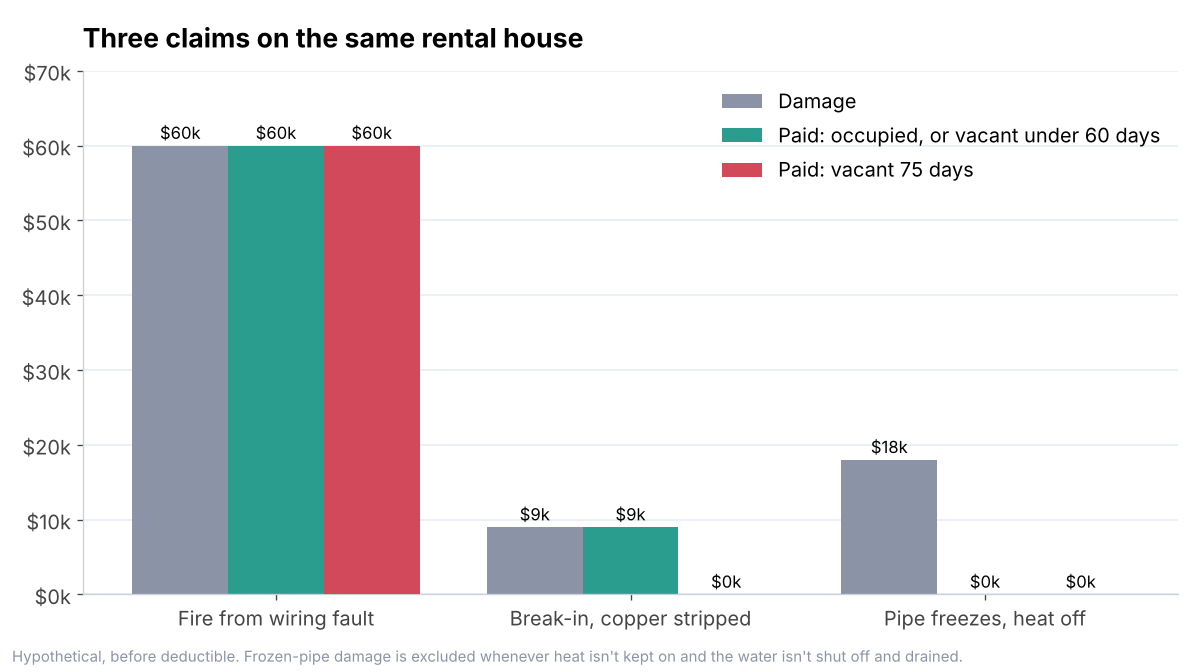
The fire is the claim landlords worry about, and it's mostly still covered. The claims that actually happen to empty buildings are break-ins, copper theft, squatters, and leaks nobody notices for weeks, and those are the ones the vacancy clause removes.
How turnovers cross 60 days
A clean-and-relist turnover rarely gets near the limit. Add a renovation or a slow market, and it's easy to go past it without noticing.
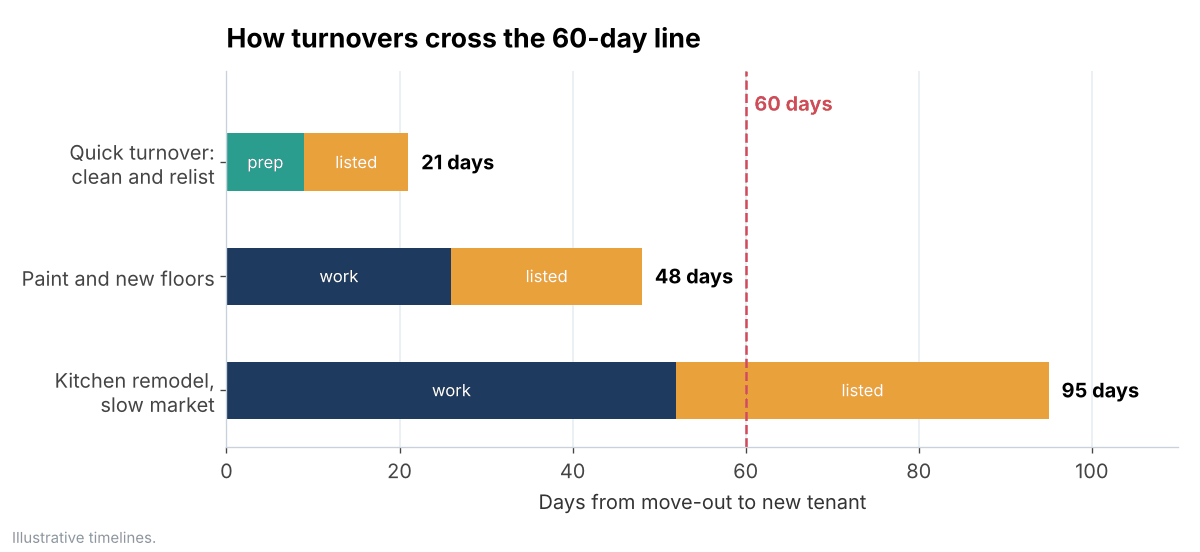
Start counting on move-out day, not the day the work starts. The work and the listing period are both vacant days.
How to keep coverage during a long vacancy
Tell your insurer before day 60. Ask exactly what changes and what's available. Notice in writing protects you better than a phone call.
Ask for a vacancy permit endorsement. Many insurers will add one for an extra premium. It suspends the vacancy restrictions for a set period, often 30 to 180 days, sometimes with conditions such as heat and regular inspections.
Consider a vacant dwelling policy. If the vacancy will be long, such as an estate property or a major renovation, a separate policy written for vacant homes may be the cleanest option. It often costs more and covers less than a regular dwelling policy, but it covers what a regular policy no longer does.
Get the renovation in writing. If the work counts as construction under your policy, the vacancy clause may not apply. Some insurers will instead want a builder's risk policy for larger projects.
Handle the water. Either keep the heat on, typically at least 55°F, or shut off the water at the main and drain the system. Doing neither is excluded, occupied or not. Water leak sensors and an automatic shutoff valve add another layer.
Make it look lived in. Keep lights on timers, keep the yard mowed and the snow shoveled, stop mail pile-ups, and inspect the property at least weekly. Log every visit with date-stamped photos. If something does happen, the log helps show when, and that the property was maintained.

A turnover checklist for landlords
- Note the move-out date. That's day 1.
- Estimate the realistic vacancy, including work, listing, and screening.
- If it could pass 45 days, contact the insurer now.
- Set heat to at least 55°F, or shut off and drain the water.
- Remove valuables, appliances you don't need to leave, and anything that attracts break-ins.
- Set up lights on timers and arrange regular visits.
- Photograph every room on move-out day and at each visit.
- Put the contractor's start and end dates in writing.
- Recheck the policy if the vacancy runs longer than planned.
Frequently asked questions
Does the 60-day clock reset if I stay there a few nights? Usually not. Most policies count occupancy as someone living there, not a short visit. Furnishing the home and staying occasionally may make it unoccupied rather than vacant, which can change which restrictions apply.
Is a seasonal home vacant every winter? Usually not. A furnished seasonal home is generally unoccupied rather than vacant, and many homeowners policies are written to cover it, with conditions about heat or draining the pipes. Read the freezing section closely.
My policy doesn't mention vacancy. Am I fine? Look again under the conditions, the exclusions, and each peril's definition. The restriction is often written inside the vandalism peril rather than as a separate clause.
Does a for-sale listing count as occupancy? No. Showings don't make a building occupied.
Sources and further reading
- Insurance Information Institute: What is covered by standard homeowners policies
- National Association of Insurance Commissioners: Consumer insurance resources
- U.S. Department of Energy: Preventing frozen pipes and home energy tips
Hypothetical figures. General information only, not insurance or legal advice. Vacancy definitions and restrictions vary by insurer, policy form, and state; your policy wording controls.